This blog is all about emerging future technologies which might seem unreal but these technologies is going to shape our future.
Tuesday, June 15, 2010
Hungry Batteries

Tuesday, June 1, 2010
Intel plans to bring free energy for mobile phones

Intel reported that it is currently pursuing research to generate electrical energy from sources like sunlight and body heat. The company believes that the energy reserved would be enough to power a mobile phone without requiring it to recharge ever again !
Already there are eco-friendly watches that do run from body heat and even more interesting there are cell phones which have displays that doubles as solar cells. So this may not be as impossible as you may think. Intel thinks the energy can even be generated even from the mobile phone’s trackball/joystick. The idea is to create energy from any other existing forms of energy sources around.
Justin Rattner, chief technology officer at Intel says, “Wouldn’t it be nice if, in fact, you were able to go almost indefinitely without charging the battery, if you were able to scavenge enough free energy from the environment?“. Hell…Yes !
Thursday, May 27, 2010
Lemon turns juice into energy, runs a clock

Saturday, May 22, 2010
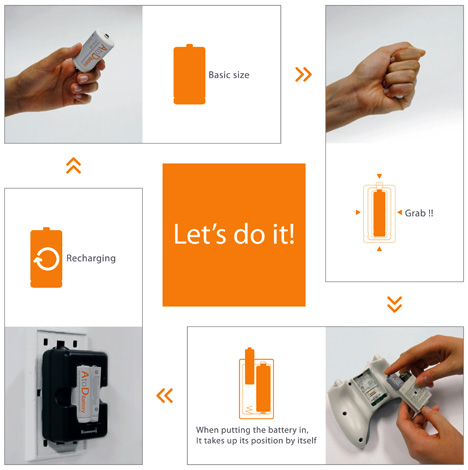
Amazing rechargeable battery concept that fits all shapes and sizes

Different battery sizes have always been a concern. Although AA batteries are relatively popular, you never know what your next gadget will need. It may require a AAA, C or even a D. No wonder every one on Earth probably wishes if only we had a battery that will fit everywhere…something that will convert itself into AA or AAA or C or D, whenever we need. Well…here’s a cool concept from designers Pyeong Joo Goh, Jong Seung Choi and Ji Soo Hong, that seems to resolve the problem.
The battery will be made from MemoryForm, so it can be squeezed into any of the required shape & size and fit into the product. It is appropriately named, AtoD, to show the fact that it can work as any of the four types i.e. AA, AAA, C or D. Inside, it will be powered by 1.5 Volts of Nickel Hydroxide, so recharging will never be an issue either.
Ultra-thin paper capacitors

If you think that thinner electronic devices are the future, then you are probably right. As time passes by, electronics is becoming smaller, to a scale that is now being referred as nanotechnology. But to power these devices you will probably require a similarly thin power-source. Thanks to Stanford University, researchers there identified that Single Walled Carbon Nanotubes (SWNTs) can be printed on paper, and then treated with polyvinylidene fluoride to create ultra-thin super-capacitors, that will be able to store energy.
The source of energy will also be very stable. “The device also showed an excellent cycling stability, with very little loss of capacitance after 2500 cycles.” In short, these paper-capacitors are the future. We have seen significant developments in nanotechnology in the last ten years. But in order to make ultra-thin computers (a.k.a. computers of the future) a similarly sized power supply has always been necessary. And it sure looks like we are heading to the right direction!
In the paper supercapacitor, all the necessary components are integrated onto a single sheet of paper in the form of single walled carbon nanotubes (SWNTs). High-speed printing could be used to print the SWNTs directly onto a piece of paper - anything from Xerox paper to newspaper and even grocery ads will work. At first, the researchers found that the SWNTs were so small that they penetrated the paper through micron-sized pores, which would cause the device to short-circuit. To solve this problem, the researchers first coated both sides of the paper with polyvinylidene fluoride (PVDF), which blocked the pores but still allowed for electrolytes to be transported through the paper. As such, the treated paper could function as an electrolytemembrane and separator without short-circuiting.
“The key design is that SWNTs stick well on paper and do not penetrate through paper completely to avoid shorting,” Yi Cui of Stanford University toldPhysOrg.com.
Once the SWNTs were printed onto the treated paper, they experienced strong bonding forces similar to those experienced when writing with a pen or pencil on paper. Even when rubbed or subjected to tape, the SWNTs remained attached to the paper. After printing SWNTs on both sides of single sheets of paper, electrolyte was loaded to form a supercapacitor. The SWNTs served as both the electrodes and current collectors in the supercapacitor, which had a capacitance of about 3 F/g. The device also showed an excellent cycling stability, with very little loss of capacitance after 2500 cycles. The researchers say the same concept could be extended to make batteries, as well.
The fully integrated supercapacitor is based on an earlier version that the researchers made, in which nanomaterials were coated separately onto different anode and cathode substrates and then assembled together with a separator. The advantage of the new integrated structure is that it allows for high-speed printing, which greatly reduces fabrication costs and brings disposable, flexible, and lightweight paper electronics closer to reality. Cui said that, in the future, the researchers plan “to use this new design for real applications.”
Monday, April 12, 2010
Hydrogen fuel cell
Hydrogen is contained in almost everything around us, but is rarely found in its pure form. Most of the time, it is bonded with other elements in compounds such as natural gas and water. Hydrogen has to be extracted from these compounds through a manufacturing process that adds energy to break the bonds that hold the compounds together.
A fuel cell converts fuel to power through an electrochemical energy conversion. Using fuel and oxygen from the air, it produces electricity, water and heat. Water – pure H2O – is the only waste product emitted when hydrogen is used as a fuel in a fuel cell. A fuel cell can generate power almost indefinitely, for as long as fuel is supplied. Plus, a fuel cell is modular and can be scaled up by adding more cells to power everything from cell phones to automobiles to entire buildings.

The Hydrogen Fuel Cell
A hydrogen fuel cell electrochemically combines hydrogen and oxygen to generate electricity, water and heat. There are no other emissions. Different types of fuel cells use different electrolytes with different electrochemical reactions occurring, but the overall reaction is the same.
The basic structure of a fuel cell consists of an electrolyte layer in contact with an anode and a cathode.
Typically, fuel is fed continuously to the anode and an oxidant (e.g., oxygen from air) is fed continuously to the cathode. The electrolyte layer acts as a one-way door, allowing either positive or negative ions to travel across, but not electrons, forcing electrons to travel through the external circuit (electric current). This resulting electric current can be used to power electrical appliances.
Benefits of Hydrogen Fuel Cells
When it comes to converting fuel to power, the fuel cell is two to three times more efficient than the internal combustion engine, which is one reason why every major automobile manufacturer in the world is investing in the development of fuel cells. Fuel cells can offer significant benefits over traditional energy technologies including:
- Superior fuel efficiency,
- Hydrogen Fuel Cells have zero to near-zero emissions in comparison to combustion engines,
- Versatility – hydrogen fuel cells can be applied in micro, portable, stationary, and transportation applications,
- Low maintenance costs, due to few moving parts,
- Modular design allowing for low cost high volume manufacturing,
- Design freedoms and,
- Quiet operation.
Hydrogen Fuel cells are on the road and being used in our communities – now.
Fuel cells have been around since 1839, but it has taken many years for us to understand the range and value of their potential applications. Today, with the support of governments and the private sector, hundreds of companies worldwide are working towards making fuel cell technology a reality. Similar to the commercialization of the electric light bulb nearly one hundred years ago, today’s companies, government departments and end user organizations are driven by technical, economic and social forces to make the hydrogen fuel cell part of our everyday lives.
Hydrogen Fuel Cells - Science Terminology
- Anode: the negatively charged terminal of an energy cell or storage battery
- Cathode: the positively charged terminal of an energy cell or storage battery
- Proton: a positively charged hydrogen ion
- Electron: a negatively charged sub-atomic particle
- Electrolyte: a chemical compound that allows conduction of ions, but not electrons
- Electrochemical Conversion: an electrochemical process that converts chemical energy to electrical energy
Wednesday, March 31, 2010
Heading towards a green energy


Wednesday, March 24, 2010
Forget Solar Power, Human Power is the Future
That may be a little aggressive, but Princeton University engineers have developed a device that may change the way that we power many of our smaller gadgets and devices. By using out natural body movement, they have created a small chip that will actually capture and harness that natural energy to create enough energy to power up things such as a cell phone, pacemaker and many other small devices that are electronic.
The chip is actually a combination of rubber and ceramic nanoribbons. When the chip is flexed, it generates electrical energy. How will this be put to use? Think of rubber soled shoes that have this chip embedded into them and every time a step is taken, energy is created and stored. Just the normal walking around inside the office during a normal work day would be enough to keep that cell phone powered every day.