Showing posts with label Gadget. Show all posts

Saturday, August 28, 2010

M-Dess


This could just have been one of the many special elements of a sci-fi flick or otherwise would you have believed, a gorgeous black dress doubling as a cellphone? Dubious as it may sound, this dress called the M-Dress from CuteCircuit actually has a slot to insert sim card and antenna embodied right within the fabric, so that the person could answer calls [when the dress rings] by just bringing her palms near to the ear without having to carry a bulky cellphone!
The technology at this stage simply can’t replace a cellphone because neither there’s a way to know who’s calling [no display] nor to keep a log of all your contacts but as humans we certainly would look forward to such amazing innovations.

Friday, July 9, 2010

Fire Extinguisher lighter


Most smokers cannot live without a cigarette lighter. Although there are several available designs, we definitely found this Fire Extinguisher lighter to be interesting. Although this does look like micro fire extinguisher, make no mistake, this is a fully functional cigarette lighter.
Even the connected hose has its own functionality, “as it nests a little LED to guide your path.”
Its a pity, this thing is only available in Japan.
Price? $4.89 (approx.) 


Laser watch


If you think you have seen crazy designs on watches, then think again. Check out the Alessi Invisible Shot Laser watch. Although it’s purpose is to show time, a watch design can hardly be weirder than this. Looks exactly like a bracelet the device features a discreet button, that when pressed reflects laser light on your wrist to show the time. We think if you consider this as a bracelet that shows time, it will probably be more appropriate.
Designer for this Alessi Invisible Shot Laser watch is Andy Kurovets.


Tuesday, June 8, 2010

LED based Torch light Gloves


Slovenian designer Tilen Sepic has designed this new conceptual torch light that will make you feel like of you are one of the X-Men ! The reason for a design like this is to produce a working light without the problem of shadows being reflected in the object. The battery, powering the gloves is to be worn like a wrist band. All you need is to just to point to the object that needs the light and the optical fibers attached to gloves will take care of the rest. Zaaappped !


Tuesday, June 1, 2010

HP shows flexible plastic TFT displays


Arizona State University and HP Labs revealed the invention of the first completely flexible plastic display. This has been created by using a process called Self-Aligned Imprint Lithography (SAIL) that let HP “build a thin film transistor screen that can be rolled up without snapping or otherwise easily breaking“. The display also uses Vizplex’s E-Ink technology, currently found in eBook Readers, to increase the readability.

This new technology will be less expensive when produced in mass scale and is also much more environment friendly than conventional LCDs. HP also promises more energy efficiency and extra battery life for laptops and smartphones using this plastic TFT displays.

Wednesday, May 19, 2010

Tap-based music creation tool


Here’s a quick look at a very innovative music creation tool from designer Petr Hampl. And…no it does not have a key-bed or strings. This device has friction-sensitive sensors on the glove’s fingertips. The recorder on the back of the gloves records all the beats and rhythms from the taps by the user, which can later be edited. The recorder also sends the music to the headphone wirelessly. Great design !


Tuesday, May 18, 2010

The Dual Music Player

Entertainment is a must for all, in which music occupies an unique position. Be it classical, jazz, rock, pop, eastern or western, the beauty charms us in one way or the other. With ample opportunities for satisfying our auditory senses we find yet again an innovation from designer Kim Young Seong.

It is a dual music player, DMP, a combination of a MP3 and CD player. Portable and compact, it is nice to see how a mp3 player gets converted to a CD player. It is also compatible with blue tooth headphone. The following pictures detail you more about the design.


Friday, May 14, 2010

Braille Credit Card


A concept from Yongsuk Kim, the Braille Credit Card empowers a visually challenged person to know the amount of money that has been charged on their card. The card is able to generate the amount in Braille which makes it easier for the user to know the sum that is needed to pay. The card also has an inbuilt miniature speaker which reads aloud the figures for further assistance.

This special card could also be useful for old aged people who suffer from poor eyesight. It wouldn’t be possible for them to understand Braille but the integrated speaker could lend a helping hand.


Sunday, May 9, 2010

Rain Drum umbrella is as amusing as it sounds


You may have come across various umbrella designs, but this one really sets a new benchmark. Check out the Rain Drum umbrella. As you can predict, this umbrella literally makes sound of drums when rain drops fall on it. Consisting of tom, snare, crash, hi-hat and bass, this umbrella covers all the important drum parts. To make the sounds possible, it consists of five different sized wax-cloth made ’shades’, with different elasticities. And depending on the elasticity and size of the ’shades’, the frequency of sound emitted differs accordingly.

Of course you cannot rule out the fact that the person standing closest to you may not enjoy the sounds as much as you do, nonetheless this is a new idea, and will find its place especially in the teenage crowd. The Rain Drum umbrella is the brain child of designer Dong Min Park.


Brainwave Heating Device, microwave of the future


Care for another desktop appliance? Called the Brainwave, it is actually a desktop microwave oven which can warm up your packaged food without having you to leave the desk. You just open up the packaged food, insert it, [there's a little scanning part] and the rest is done by the device in the picture.

To make the experience more user friendly the ‘Brainwave’ meal has been designed to come with a fork that has a Radio Frequency Identification tag attached to it. There’s a scanner with the machine through which the fork is swiped just like an electronic card, so that the information about the particular meal [heat setting and time] is automatically recognized by the microwave.So it makes heating your food that easy.”The microwave is powered through a C8 port connected to the mains and controlled through a computer application connected via USB.” This Brainwave Desktop Microwave has been designed by London based designer Steve Gates.


Sunday, May 2, 2010

Good Bye Floppy !!!!!!!

Stop us if you've heard this before: the floppy drive is dead. Sony has announced that it will stop selling the long-running storage medium next year.

According to the BBC, the end of floppy sales in Japan coupled with Sony's dropping international floppy sales earlier this year sticks the proverbial fork in the finicky, low-capacity storage medium.

Well, almost. The venerable 3.5-inch floppy is still available from the likes of Verbatim, Imation (3M), and Maxell- although Sony's abandonment of the once-ubiquitous media moves it another giant step towards utter irrelevance.

But the floppy's journey to inconsequentiality has been one long, slow slog.

When Steve Jobs announced his company-saving iMac in May of 1998, its lack of a floppy drive was met with an outcry of outrage - but the handwriting was on the wall. And it said: "Goodbye, floppy."

When the iMac shipped in August of that year, reviews of its floppylessness were mixed.Macworld, for example, wrote: "The most shocking part of the iMac isn't what it offers, but what it lacks. The iMac has no floppy drive, which might be forgivable if there were a Zip drive or other removable-media option, but there isn't."

Others, however, were more understanding. Ars Technica for example, noted: "Apple has gotten a lot of heat for dumping the floppy, but I don't have any problem with the action in principle. It's high time we move ourselves away from this pathetically small kind of storage."

Soon, more rumors of the floppy's demise began to circulate. At its 1999 Developer Forum, devs were told to prepare for a floppy-free future. In 2001, Intel hustled to deny that it was advising the removal of floppy drives from PCs, as had been revealed in internal documents.

Then, in 2003, Dell said it would drop the flop, which hastened the inexorable decline of the sales of the diskettes. In 2007, floppies disappeared from UK retailer PC World's shelves.

Not that there wasn't a gaggle of floppy replacements floated by various and sundry manufacturers. Insite's Floptical drive - which guided the read-write head optically but used standard magnetic storage techniques - increased the little fellow's capacity to 21MB. This hybrid tech resurfaced in Imation's 120MB SuperDisk - but that drive met with only limited success.

Other manufacturers tried putting flexible media into different high-capacity removable-disk technologies even before the floppy's demise - Iomega's 100MB Zip Drive, introduced in May 1995, being arguably the most successful.

In those removable-disk salad days, cartridges based on rigid-disk technologies were also being popped into internal and external drives - most notably SyQuest (bought by Iomega in 1999), followed by Iomega's 1GB and 2GB Jaz and 35GB "Son of Jaz," the Rev. During the waning days of rigid removables, SyQuest founder Syed Iftikar's start-up Castlewood flogged the 2GB Orb drive to little success.

And no trip down removable magnetic-media memory lane would be complete without at least a passing nod to Iomega's two-inch Clik!, introduced in 1999 and rebranded in 2000 as the Pocket Zip. As Iomega admits, "These products met limited market acceptance and were eventually discontinued."

The Zip drive - which was boosted to 250MB in 1998 and to 750MB in 2002 - was a follow-on to Iomega's Bernoulli Box technology. It was the only high-capacity flexible-media removable adopted to any great degree by OEMs. That success was never matched by other attempts such as Sony's 200MB HiFD, Samsung's 123MB Pro-FD, Matsushita-Kotobuki's 32MB FD32MB, or the aforementioned Imation SuperDisk.

Floppies, on the other hand, were everywhere during their heyday. Starting out in the early 1970s in an 8-inch form factor, they became de rigueur in early S-100 CP/M systems, especially after the DSDD (double-sided, double-density), 1.2MB version was released in the late 70s.

Floppies then shrank to 5.25 inches, popularized in the Apple II and IBM Personal Computers. When the 3.5-inch floppy appeared in the early 1980s the magnetic disk itself remained flexible, but it was encased in a hard-plastic case - which undoubtedly led to puzzlement among the younger generation of PC users, who wondered where the term "floppy" came from.

The most popular of those 3.5-inch disks began at 400KB (as in the original 128K Macintosh), then grew to 800KB (as in the Macintosh 512ke) and finally stabilized with 1.44MB FDHD format in the late 80s - which Apple, in its characteristically understated marketing-speak, dubbed the SuperDrive.

But as file sizes grew, floppies were doomed. Their first serious competition were CD-R andCD-RW drives - although the latter never managed to deal the floppy the final death blow.

That coup de grâce came with the introduction of flash-based thumb drives, which soon became the new hotness. Not only did thumb-drive capacities quickly rise and prices quickly fall, but their portability, relative speed, and reliability soon made them sneakernet's go-to media. Faster LANs, simplified PC-to-PC file-sharing, and broadband also made both simple drag-and-drop file-sharing and emailing more-secure methods of transfering files.

To be sure, floppies put up a good fight. Witness, for example, Maplin's combo floppy-drive-cum-card-reader of 2008. But thumb drives were not to be denied - although Memorex did give a nod to nostalgia with its retro FlashDisc offered by Buffalo and Verbatim.

And now with Sony's announcement, Steve Jobs gets to say "I told you so." ®


Wednesday, April 28, 2010

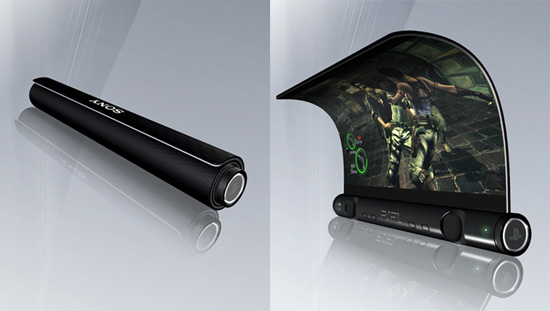
PlayStation Portable 2


There has recent predictions that the Sony’s future handheld game console, PSP2 will have a scrolling OLED screen. The following design by Tai Chiem is ridiculously catchy and hard to miss. It sould supposedly have wireless connectivity, bluetooth 2.0 and dual speakers. And exactly how would Sony keep the screen straight? This seems to be done using an electrical charge. Overall PSP2 looks to be an awesome product.


Sunday, April 25, 2010

Super vision from Nike for bicyclists

If you are an avid bicyclist, finally your prayers may have been answered. There are many irrational motorists on the road, from whom you have to keep yourself safe.

The Nike Hindsight gives you near super-human powers by providing you extended peripheral vision


By using fresnel lenses on the two sides of the glasses, cyclists can view area beyond the normal 180º! Although the vision is distorted across the periphery, the eye detects only motion in that area and therefore only nominal clarity is lost overall. Because of the powerful fresnel lenses the cyclist can view an extra 25º on both sides.


You do not have to turn your head everytime you think a vehicle is behind, the Nike Hindsight will pretty much take care of it. Although originally intended for bicyclists, these glasses can be used for quite a number of other sports.


Wednesday, April 14, 2010

What Will Motorola’s Future Phones Look Like in 2033?


Motorola’s designers, from five different offices around the globe, have been dedicating a portion of their time since late last year to a project called “Motorola 2033.” The initiative, under the auspices of the Consumer Experience Design team (CXD), uses the 25th anniversary of the mobile phone as an opportunity to imagine mobile device design 25 years on, resulting in a curious set of research-based blue sky concepts rooted in some fantastical, yet plausible suppositions.
The results range from the relatively obvious (a phone embedded in a ring), to the technologically unlikely (’Minority Report’ style gestures and floating screens), and the genuinely inspiring–especially when they start leveraging the extensive non-US, non-Europe influence in their distributed team.


Wednesday, April 7, 2010

Backpacker’s Diary


Imagine you are a person that loves travelling and to discover new things in the nature.
While walking through a large forest into the mountains you are amazed by the beauty of the flora and fauna diversity and you can’t help yourself to take some nice detailed pictures to show them to your friends after coming back home.

But why to wait until you are back, and not share these while you are still in the middle of the nature?
The Backpacker’s Diary concept is the right tool for this, and more than that it allows you to do many other things with the help of next-generation technologies, making your trip the most perfect and full of discoveries.


It is called the Backpacker’s Diary because it has the form of a traveling diary measuring 10x12x2 inches and is carried in your backpack, together with the other stuff required for your comfort, like the sleeping bag.
But it is not an ordinary book because each page has different functions based on different technologies.
For example, one of the pages is the media recorder, then comes the EL illumination, other page is a keyboard and the next one is an LCD display.

The EL illumination, also called Electroluminescence, is an optical and electrical phenomenon where a material emits light in response o an electric current passed through it, or to a strong electric field.
It is used in lighting applications or information displays, but in our forest, it would light the small area where we are sleeping during the night.

This diary concept is created using flexible materials in a large number to add easy of use and durability in the outside conditions.
It needs to be powered by something and as in the nature you don’t have plugs, and besides that, you love the environment and want to keep it green, the solar charging is the best solution adopted by its designers, and it is done via the flexible solar panel during walking

If you have such a computer with you during the trip, you can get in touch with the other Backpackers’ holders and share all the information you have wirelessly, including route, weather, location coordinates provided by the built-in GPS system, as well as pictures, videos or sounds of the nature recorded with the digital bookmark worn in your chest pocket and transferred into the diary.

As for the hardware part, the main components like battery, processor and other electronics are kept into the backpack which is made of high-intensity plastic.