Wednesday, April 14, 2010

What Will Motorola’s Future Phones Look Like in 2033?


Motorola’s designers, from five different offices around the globe, have been dedicating a portion of their time since late last year to a project called “Motorola 2033.” The initiative, under the auspices of the Consumer Experience Design team (CXD), uses the 25th anniversary of the mobile phone as an opportunity to imagine mobile device design 25 years on, resulting in a curious set of research-based blue sky concepts rooted in some fantastical, yet plausible suppositions.
The results range from the relatively obvious (a phone embedded in a ring), to the technologically unlikely (’Minority Report’ style gestures and floating screens), and the genuinely inspiring–especially when they start leveraging the extensive non-US, non-Europe influence in their distributed team.


Monday, April 12, 2010

Hydrogen fuel cell

Hydrogen is contained in almost everything around us, but is rarely found in its pure form. Most of the time, it is bonded with other elements in compounds such as natural gas and water. Hydrogen has to be extracted from these compounds through a manufacturing process that adds energy to break the bonds that hold the compounds together.

A fuel cell converts fuel to power through an electrochemical energy conversion. Using fuel and oxygen from the air, it produces electricity, water and heat. Water – pure H2O – is the only waste product emitted when hydrogen is used as a fuel in a fuel cell. A fuel cell can generate power almost indefinitely, for as long as fuel is supplied. Plus, a fuel cell is modular and can be scaled up by adding more cells to power everything from cell phones to automobiles to entire buildings.


The Hydrogen Fuel Cell

A hydrogen fuel cell electrochemically combines hydrogen and oxygen to generate electricity, water and heat. There are no other emissions. Different types of fuel cells use different electrolytes with different electrochemical reactions occurring, but the overall reaction is the same.

The basic structure of a fuel cell consists of an electrolyte layer in contact with an anode and a cathode.

Typically, fuel is fed continuously to the anode and an oxidant (e.g., oxygen from air) is fed continuously to the cathode. The electrolyte layer acts as a one-way door, allowing either positive or negative ions to travel across, but not electrons, forcing electrons to travel through the external circuit (electric current). This resulting electric current can be used to power electrical appliances.

Benefits of Hydrogen Fuel Cells

When it comes to converting fuel to power, the fuel cell is two to three times more efficient than the internal combustion engine, which is one reason why every major automobile manufacturer in the world is investing in the development of fuel cells. Fuel cells can offer significant benefits over traditional energy technologies including:

  • Superior fuel efficiency,
  • Hydrogen Fuel Cells have zero to near-zero emissions in comparison to combustion engines,
  • Versatility – hydrogen fuel cells can be applied in micro, portable, stationary, and transportation applications,
  • Low maintenance costs, due to few moving parts,
  • Modular design allowing for low cost high volume manufacturing,
  • Design freedoms and,
  • Quiet operation.

Hydrogen Fuel cells are on the road and being used in our communities – now. Vancouver commuters have been riding on hybrid fuel cell-natural gas buses since 1997. Ford Motors Company recently developed the Ford Focus Fuel Cell Vehicle (FCV) and presented a fleet to the Vancouver Fuel Cell Vehicle Program. Drivers from BC Hydro, BC Transit, Ballard Power Systems, the City of Vancouver, Fuel Cells Canada, the National Research Council (NRC), Natural Resources Canada and the Government of British Columbia will use state-of-the-art Ford Focus FCVs for their daily driving as part of a three-year hydrogen fuel technology demonstration program.

Fuel cells have been around since 1839, but it has taken many years for us to understand the range and value of their potential applications. Today, with the support of governments and the private sector, hundreds of companies worldwide are working towards making fuel cell technology a reality. Similar to the commercialization of the electric light bulb nearly one hundred years ago, today’s companies, government departments and end user organizations are driven by technical, economic and social forces to make the hydrogen fuel cell part of our everyday lives.

Hydrogen Fuel Cells - Science Terminology

  • Anode: the negatively charged terminal of an energy cell or storage battery
  • Cathode: the positively charged terminal of an energy cell or storage battery
  • Proton: a positively charged hydrogen ion
  • Electron: a negatively charged sub-atomic particle
  • Electrolyte: a chemical compound that allows conduction of ions, but not electrons
  • Electrochemical Conversion: an electrochemical process that converts chemical energy to electrical energy

Sunday, April 11, 2010

Skateboard Car


Some genius just came up with a brilliant idea to motorize a skateboard which apparently can be navigated via a joystick or even a mouse! The drive-by-wire runs on hydrogen and can be customized to fit any car body known to man so far. So you can technically own a Porsche, a Ferrari, and an Aston Martin all in one! Really mind-boggling.

Saturday, April 10, 2010

Metromorph Futuristic Car


To address the ever-growing metropolitan city problems associated with real estate and parking place, many innovative ideas are constantly coming up from various designers and Metromorph is one of the most functional concept cars in this regard. It has been designed with the ability to ride up just like an elevator and turn into a balcony, eliminating the harassment of parking and paying for additional space in the apartment. This vehicle is powered with two in-wheel motors placed in the back of the car along with two battery cases.

Rotating arms have been used in order to keep the seats level for both vertical and horizontal drive. When the vehicle is in balcony mode, the seats are positioned on a rolling base which allows them to become lounge chair for lying down and relax. The exterior design of this car never seems like a car that is mounted vertically with a building but still it looks like a vehicle on the road. The wheels are hidden towards inside and doors are designed to rotate closely around the car, instead of the usual pulling out or sliding up doors, allowing the entrance to freely open in narrow area like a garage.


Friday, April 9, 2010

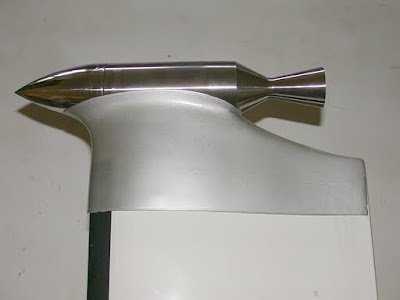
Strap-on Rocket-Powered Personal Helicopter

How crazy it seems today to be have a backpack which carry you to your desired destination place via air........? But in future you might be one to hang on this to travel to your friend's door, it might become a style statement and passion of many people to ride this as that of riding a sports bike.......


By using tiny rocket motors at the tips of the rotor blades, the Libelula eliminates the torque which makes a tail rotor necessary in a conventional helicopter. This in theory makes it much more reliable, which is a good thing when you’re hanging from a backpack a few hundred feet above terra firma. (Pics)

The rockets are installed in a military UAV helicopter, they are only 1-1/2″ in diameter and less than 10″ long and with this engines a rotor blade produced more than 2200 lbs of lift.


The best thing about this kind of helicopter is that it doesn’t need a tail rotor. The outer rockets don’t cause any torque, so with a simple vane, it becomes the simplest form of a helicopter, and the easiest and safer to fly.

Because 80% of the helicopter accidents are blamed to tail rotor failure, this eliminates that problem.


Thursday, April 8, 2010

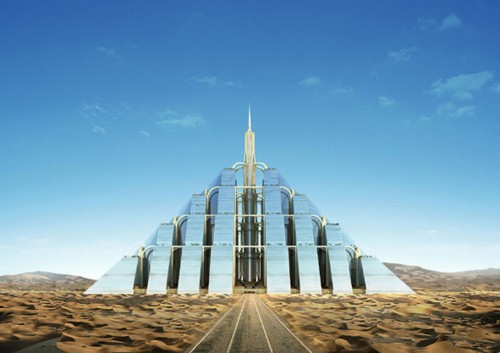
Ziggurat - a future city


Timelinks — the leading ecological company of the project, has chosen Dubai to create a viable city of the future.

The city in the form of a futuristic pyramid can carry out ability to live to one million person, using power of the nature. Ridas Matonis, general director Timelinks, has told: “Community «Ziggurat» completely самоcтоятельно will provide the residing for the account of steam energy, a wind power and natural natural resources of district”.

Timelinks underlines, that the project does not destroy natural ecology of district as the base of buildings reclines all on 10% of a surface of the earth. Public and private agriculture not only will brighten up leisure to many inhabitants, but also will improve appearance of constructions. On all complex 360-degree transport messages will be laid, thus — cars remain not with affairs — in any point of constructions possibility very quickly will reach on foot.


Wednesday, April 7, 2010

Backpacker’s Diary


Imagine you are a person that loves travelling and to discover new things in the nature.
While walking through a large forest into the mountains you are amazed by the beauty of the flora and fauna diversity and you can’t help yourself to take some nice detailed pictures to show them to your friends after coming back home.

But why to wait until you are back, and not share these while you are still in the middle of the nature?
The Backpacker’s Diary concept is the right tool for this, and more than that it allows you to do many other things with the help of next-generation technologies, making your trip the most perfect and full of discoveries.


It is called the Backpacker’s Diary because it has the form of a traveling diary measuring 10x12x2 inches and is carried in your backpack, together with the other stuff required for your comfort, like the sleeping bag.
But it is not an ordinary book because each page has different functions based on different technologies.
For example, one of the pages is the media recorder, then comes the EL illumination, other page is a keyboard and the next one is an LCD display.

The EL illumination, also called Electroluminescence, is an optical and electrical phenomenon where a material emits light in response o an electric current passed through it, or to a strong electric field.
It is used in lighting applications or information displays, but in our forest, it would light the small area where we are sleeping during the night.

This diary concept is created using flexible materials in a large number to add easy of use and durability in the outside conditions.
It needs to be powered by something and as in the nature you don’t have plugs, and besides that, you love the environment and want to keep it green, the solar charging is the best solution adopted by its designers, and it is done via the flexible solar panel during walking

If you have such a computer with you during the trip, you can get in touch with the other Backpackers’ holders and share all the information you have wirelessly, including route, weather, location coordinates provided by the built-in GPS system, as well as pictures, videos or sounds of the nature recorded with the digital bookmark worn in your chest pocket and transferred into the diary.

As for the hardware part, the main components like battery, processor and other electronics are kept into the backpack which is made of high-intensity plastic.