Thursday, April 29, 2010

World’s largest complete functional plastic building in Taiwan


You are about to get bewildered because what you are seeing is no doubt a building but one that has been constructed from recycled PET plastic bottles. This three story building in Taipei, Taiwan reuses about 1.5 million discarded bottles accumulated from trash cans. The building which is 130m in length, 40 m in width and 26m in height has walls, made of bottles that have been given a brick like structure with special honeycomb geometry.

The structure of the bottle bricks allows it to be filled with air so that it could act as an insulator in hot summer months.There’s also a provision for filling the bricks with sand or water to let them absorb sunlight for keeping the interior warm, as required in cooler places.The bricks are even strong enough to empower buildings to withstand natural calamities like earthquake or typhoons. For protection against fire the outer part of the building has a fire proof coating while the interior implements the usual safety measures.

In addition to the recycled bottles the building adds on certain other green factors as well.In the morning the rooms would be lit by the entering sunlight while in the evening the building would use energy saving LEDs. This pavilion presently called the EcoARK would be used as an exhibition site for the Taipei International Flora Expo in November.


Wednesday, April 28, 2010

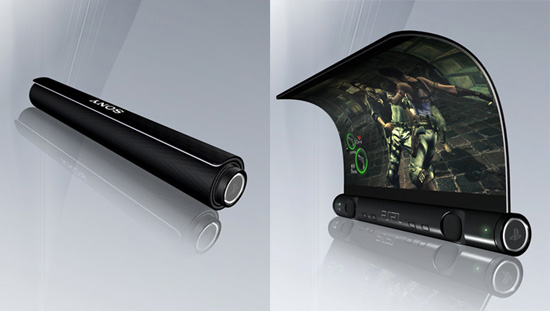
PlayStation Portable 2


There has recent predictions that the Sony’s future handheld game console, PSP2 will have a scrolling OLED screen. The following design by Tai Chiem is ridiculously catchy and hard to miss. It sould supposedly have wireless connectivity, bluetooth 2.0 and dual speakers. And exactly how would Sony keep the screen straight? This seems to be done using an electrical charge. Overall PSP2 looks to be an awesome product.


Tuesday, April 27, 2010

Honda’s revolutionary Great Race of 2025 vehicle

Honda Research North America is coming up with a revolutionary vehicle. The purpose…Great Race of 2025! This truly all-terrain power-packed vehicle will navigate on land, air and water.

The race will actually require all vehicles to circumnavigate the globe within a 24 hour period which would consist of navigation on land in United States, by sea through Asia and by air over Europe!

This vehicle will have specialized sensors to assist in the determination of changes in speed, altitude and the type of terrain which would help it to switch to the required configuration.


Sunday, April 25, 2010

Super vision from Nike for bicyclists

If you are an avid bicyclist, finally your prayers may have been answered. There are many irrational motorists on the road, from whom you have to keep yourself safe.

The Nike Hindsight gives you near super-human powers by providing you extended peripheral vision


By using fresnel lenses on the two sides of the glasses, cyclists can view area beyond the normal 180º! Although the vision is distorted across the periphery, the eye detects only motion in that area and therefore only nominal clarity is lost overall. Because of the powerful fresnel lenses the cyclist can view an extra 25º on both sides.


You do not have to turn your head everytime you think a vehicle is behind, the Nike Hindsight will pretty much take care of it. Although originally intended for bicyclists, these glasses can be used for quite a number of other sports.


Thursday, April 22, 2010

X-36

Soon Fighter Planes are going to loose their tail


McDonnell Douglas and the National Aeronautics and Space Administration (NASA) have developed a tailless research aircraft that could dramatically change the design of future stealthy fighters. Named the X-36, the vehicle has no vertical or horizontal tails and uses new split ailerons to provide yaw (left and right) and pitch (up and down) directional control. This innovative design promises to reduce weight, drag and radar signature and increase range, maneuverability and survivability of future fighter aircraft. The 28-percent scale prototype was designed, developed and produced in just 28 months for only $17 million. The X-36 began a six-month flight test program in the summer of 1996.

McDonnell Douglas and the National Aeronautics and Space Administration (NASA) embarked on a joint project in 1994 to develop a prototype fighter aircraft designed for stealth and agility. The result -- after only 28 months -- was a subscale tailless aircraft called the X-36. The 28 percent scale, remotely piloted X-36 has no vertical or horizontal tails, yet it is expected to be more maneuverable and agile than today's fighters. In addition, the tailless design reduces the weight, drag and radar cross section typically associated with traditional fighter aircraft.

In a series of flight tests, the low-cost X-36 research vehicle demonstrated the feasibility of using new flight control technologies in place of vertical and horizontal tails to improve the maneuverability and survivability of future fighter aircraft. During flight, the X-36 used new split ailerons and a thrust-vectoring nozzle for directional control. The Ailerons not only split to provide yaw (right-left) control, but also raise and lower asymmetrically to provide roll control. The X-36 vehicle also incorporated an advanced, single-channel digital fly-by-wire control system developed with commercially available components.

Fully fueled, the X-36 prototype weighed 1,300 pounds. It is 19 feet long and measures 11 feet at its widest point. It is 3 feet high and is powered by a Williams Research F112 engine that provides about 700 pounds of thrust. Using a video camera in the nose of the vehicle, a pilot controls the flight of the X-36 from a virtual cockpit -- complete with head-up display (HUD) -- in a ground-based station. This pilot-in-the-loop approach eliminates the need for expensive and complex autonomous flight control systems.

McDonnell Douglas has been working under contract to NASA Ames Research Center, Moffett Field, Calif., since 1989 to develop the technical breakthroughs required to achieve tailless agile flight. Based on the positive results of extensive wind tunnel tests, McDonnell Douglas in 1993 proposed building a subscale tailless research aircraft. In 1994 McDonnell Douglas and NASA began joint funding of the development of this aircraft, now designated the X-36. Under the roughly 50/50 cost-share arrangement, NASA Ames is responsible for continued development of the critical technologies, and McDonnell Douglas for fabricating the aircraft.

McDonnell Douglas built the X-36 with a combination of advanced, lowcost design and manufacturing techniques pioneered by the company's Phantom Works research-and-development operation.

Among these techniques are:

  • advanced software development tools for rapid avionics prototyping;
  • low-cost tooling molds;
  • composite skins cured at low termperatures without the use of autoclaves, and;
  • high speed machining of unitized assemblies.

Two identical subscale research vehicles were produced by the team for use in the flight test program. Including design and production of the two aircraft and flight testing, the total cost of the X-36 program was only $17 million. A total of 25 flights, conducted by McDonnell Douglas, took place during a six-month flight test program designed to prove the aircraft's superior agility. Initial tests focused on the low-speed, high angle-of-attack performance of the X-36.

Tuesday, April 20, 2010

Researchers designing all-electric warship


A University at Buffalo electronic-packaging researcher is helping the U.S. Navy to develop a next generation all-electric warshipthat will revolutionize the Navy’s use of weaponry and manpower.

The electric warship’s system architecture to be designed by Cemal Basaran, director of the Electronic Packaging Laboratory in the UB School of Engineering and Applied Sciences, and other researchers working on the project for the Navy will make available throughout the entire ship onboard electric power generated by the ship’s power plants and mechanical propulsion system…

The Navy plans to have the electric warship operational by 2012.

Friday, April 16, 2010

ZEEP Design’s Helicopter Car


Now, we are so fond of the flying cars, that even designers are trying their hands on some out of the world renderings of their own thought of a prospective roadable flyer. This one from the ZEEP Design show is a car that transforms into a helicopter, now that can be a realistic idea if for those cars start taking to the skies on a regular basis. (Pics)
Flying Car! The renderings from ZEEP Design show a car that can transform into a helicopter. Blades on the rotor remain folded and out of sight when not in use, and once required, they span out to convert it to a full-fledged copter. Simultaneously, the tail rotor that’s generally tucked at the car’s rear comes out to complete the transformation


The car moves on the huge front wheels, and the small black wheel (that also functions as the tail rotor) is used for steering. For controlling the CCC, the cockpit has a control sphere at the right arm and three color-coded buttons on the left arm.