Tuesday, June 1, 2010

HP shows flexible plastic TFT displays


Arizona State University and HP Labs revealed the invention of the first completely flexible plastic display. This has been created by using a process called Self-Aligned Imprint Lithography (SAIL) that let HP “build a thin film transistor screen that can be rolled up without snapping or otherwise easily breaking“. The display also uses Vizplex’s E-Ink technology, currently found in eBook Readers, to increase the readability.

This new technology will be less expensive when produced in mass scale and is also much more environment friendly than conventional LCDs. HP also promises more energy efficiency and extra battery life for laptops and smartphones using this plastic TFT displays.

Intel plans to bring free energy for mobile phones


Intel reported that it is currently pursuing research to generate electrical energy from sources like sunlight and body heat. The company believes that the energy reserved would be enough to power a mobile phone without requiring it to recharge ever again !

Already there are eco-friendly watches that do run from body heat and even more interesting there are cell phones which have displays that doubles as solar cells. So this may not be as impossible as you may think. Intel thinks the energy can even be generated even from the mobile phone’s trackball/joystick. The idea is to create energy from any other existing forms of energy sources around.

Justin Rattner, chief technology officer at Intel says, “Wouldn’t it be nice if, in fact, you were able to go almost indefinitely without charging the battery, if you were able to scavenge enough free energy from the environment?“. Hell…Yes !

Saturday, May 29, 2010

Awesome new futuristic city in Korea


Netherlands based architects MVRDV has come up with this great design of an incredible new city called Gwanggyo Power Center, located south of Seoul, South Korea. Several organic hill structures combine to form this magnificent city which will be completely self-sufficient and would support 77,000 residents.

The city includes everything (almost) …housing, offices, shops and educational facilities. There is even an internal irrigation system which stores extra water from the buildings and uses it to sustain these green facades. As MVRDV states, “This diverse program has different needs for phasing, positioning and size. To facilitate this all elements are designed as rings. By pushing these rings outwards, every part of the program receives a terrace for outdoor life.” Construction will begin sometime after 2011.


Thursday, May 27, 2010

Lemon turns juice into energy, runs a clock


You thought lemon only goes with food and beer? You were wrong. It can even run a clock, effortlessly. The theory behind the lemon clock is based on the principle of electrolysis. The combination of zinc and copper, (basically the plug under the lemon), when reacts with any acidic medium (in this case, the lemon) causes oxidation, ultimately resulting in electricity. The device below allows you to keep the clock active for over a week using just 1 lemon. Good old chemistry, makes me remember my school days.

Sunday, May 23, 2010

World’s largest airship finally surfaces


The Hindenburg disaster took place in May 6, 1937, after which people completely lost their confidence on airships. But what you see here is yet another attempt of a helium-based airship,albeit based on a much modern technology. The airship called Bullet 580, measures 235ft in length and 65ft in diameter. It can easily lift 2,000lbs and take it up to 20,000ft in the air. With its sheer size and mass, the Bullet 580 is also the world’s largest inflatable craft.

Developed by E-Green Technologies, the airship can take you ‘places’ for sightseeing and provide you with some breath taking experience. Overall manufacturing cost for the airship stands at $8.125 million and it was inflated at the Garret Coliseum in Montgomery, Alabama.


Saturday, May 22, 2010

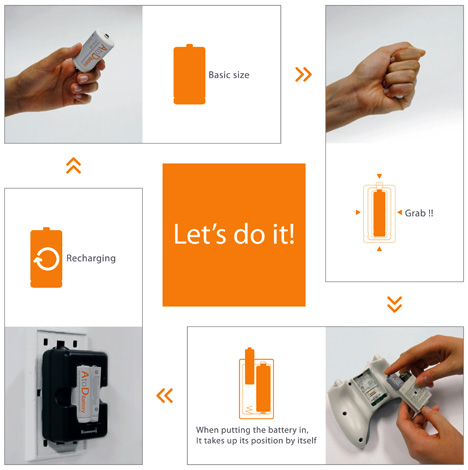
Amazing rechargeable battery concept that fits all shapes and sizes


Different battery sizes have always been a concern. Although AA batteries are relatively popular, you never know what your next gadget will need. It may require a AAA, C or even a D. No wonder every one on Earth probably wishes if only we had a battery that will fit everywhere…something that will convert itself into AA or AAA or C or D, whenever we need. Well…here’s a cool concept from designers Pyeong Joo Goh, Jong Seung Choi and Ji Soo Hong, that seems to resolve the problem.

The battery will be made from MemoryForm, so it can be squeezed into any of the required shape & size and fit into the product. It is appropriately named, AtoD, to show the fact that it can work as any of the four types i.e. AA, AAA, C or D. Inside, it will be powered by 1.5 Volts of Nickel Hydroxide, so recharging will never be an issue either.


Ultra-thin paper capacitors


If you think that thinner electronic devices are the future, then you are probably right. As time passes by, electronics is becoming smaller, to a scale that is now being referred as nanotechnology. But to power these devices you will probably require a similarly thin power-source. Thanks to Stanford University, researchers there identified that Single Walled Carbon Nanotubes (SWNTs) can be printed on paper, and then treated with polyvinylidene fluoride to create ultra-thin super-capacitors, that will be able to store energy.

The source of energy will also be very stable. “The device also showed an excellent cycling stability, with very little loss of capacitance after 2500 cycles.” In short, these paper-capacitors are the future. We have seen significant developments in nanotechnology in the last ten years. But in order to make ultra-thin computers (a.k.a. computers of the future) a similarly sized power supply has always been necessary. And it sure looks like we are heading to the right direction!

In the paper supercapacitor, all the necessary components are integrated onto a single sheet of paper in the form of single walled carbon nanotubes (SWNTs). High-speed printing could be used to print the SWNTs directly onto a piece of paper - anything from paper to newspaper and even grocery ads will work. At first, the researchers found that the SWNTs were so small that they penetrated the paper through micron-sized pores, which would cause the device to short-circuit. To solve this problem, the researchers first coated both sides of the paper with polyvinylidene fluoride (PVDF), which blocked the pores but still allowed for electrolytes to be transported through the paper. As such, the treated paper could function as an membrane and separator without short-circuiting.

“The key design is that SWNTs stick well on paper and do not penetrate through paper completely to avoid shorting,” Yi Cui of Stanford University toldPhysOrg.com.

Once the SWNTs were printed onto the treated paper, they experienced strong bonding forces similar to those experienced when writing with a pen or pencil on paper. Even when rubbed or subjected to tape, the SWNTs remained attached to the paper. After printing SWNTs on both sides of single sheets of paper, electrolyte was loaded to form a supercapacitor. The SWNTs served as both the electrodes and current collectors in the supercapacitor, which had a capacitance of about 3 F/g. The device also showed an excellent cycling stability, with very little loss of capacitance after 2500 cycles. The researchers say the same concept could be extended to make batteries, as well.

The fully integrated supercapacitor is based on an earlier version that the researchers made, in which nanomaterials were coated separately onto different anode and cathode substrates and then assembled together with a separator. The advantage of the new integrated structure is that it allows for high-speed printing, which greatly reduces fabrication costs and brings disposable, flexible, and lightweight electronics closer to reality. Cui said that, in the future, the researchers plan “to use this new design for real applications.”